Are Sarcoids in Horses Life-Threatening?
Are Sarcoids in Horses Life-Threatening?
Short answer
Sarcoids in horses are not typically life-threatening, but they can become serious enough to affect a horse’s welfare, usability, and, in some cases, long-term prognosis.
What exactly are equine sarcoids?
Equine sarcoids are the most common skin tumour in horses, accounting for a significant proportion of all equine neoplasms. They are locally invasive fibroblastic tumours associated with infection by bovine papillomavirus (BPV-1 and BPV-2).
Unlike many cancers, sarcoids:
Do not metastasise (spread to internal organs)
Tend to remain confined to the skin and surrounding tissue
Show variable behaviour depending on type and location
This distinction is important. When people ask whether sarcoids are “life-threatening,” they are often thinking in terms of cancer that spreads systemically. Sarcoids do not behave in that way.
Why sarcoids are rarely fatal
From a clinical perspective, sarcoids are not considered life-threatening because:
They do not invade vital organs
They do not spread through the bloodstream or lymphatic system
They are primarily a local disease process
Peer-reviewed studies and clinical reviews (e.g. Knottenbelt, Martens et al.) consistently classify sarcoids as non-metastatic tumours.
This means a horse will not die directly from sarcoids in the way it might from malignant cancers.
Where the real risk lies
The more relevant question is not whether sarcoids are fatal, but whether they can become clinically significant or welfare-limiting.
In some cases, they can.
1. Local invasion and tissue damage
Sarcoids can infiltrate surrounding tissue, particularly the more aggressive fibroblastic type. This can lead to:
Progressive enlargement
Distortion of local anatomy
Chronic irritation
Unlike benign lumps that remain stable, sarcoids can be locally destructive over time.
2. Location-dependent severity
The impact of a sarcoid depends heavily on where it develops.
Higher-risk locations include:
Around the eyes
The sheath or udder
Limb joints
Girth or saddle areas
In these areas, even relatively small lesions can:
Interfere with movement
Cause pain or discomfort
Prevent normal use of the horse
3. Ulceration and secondary infection
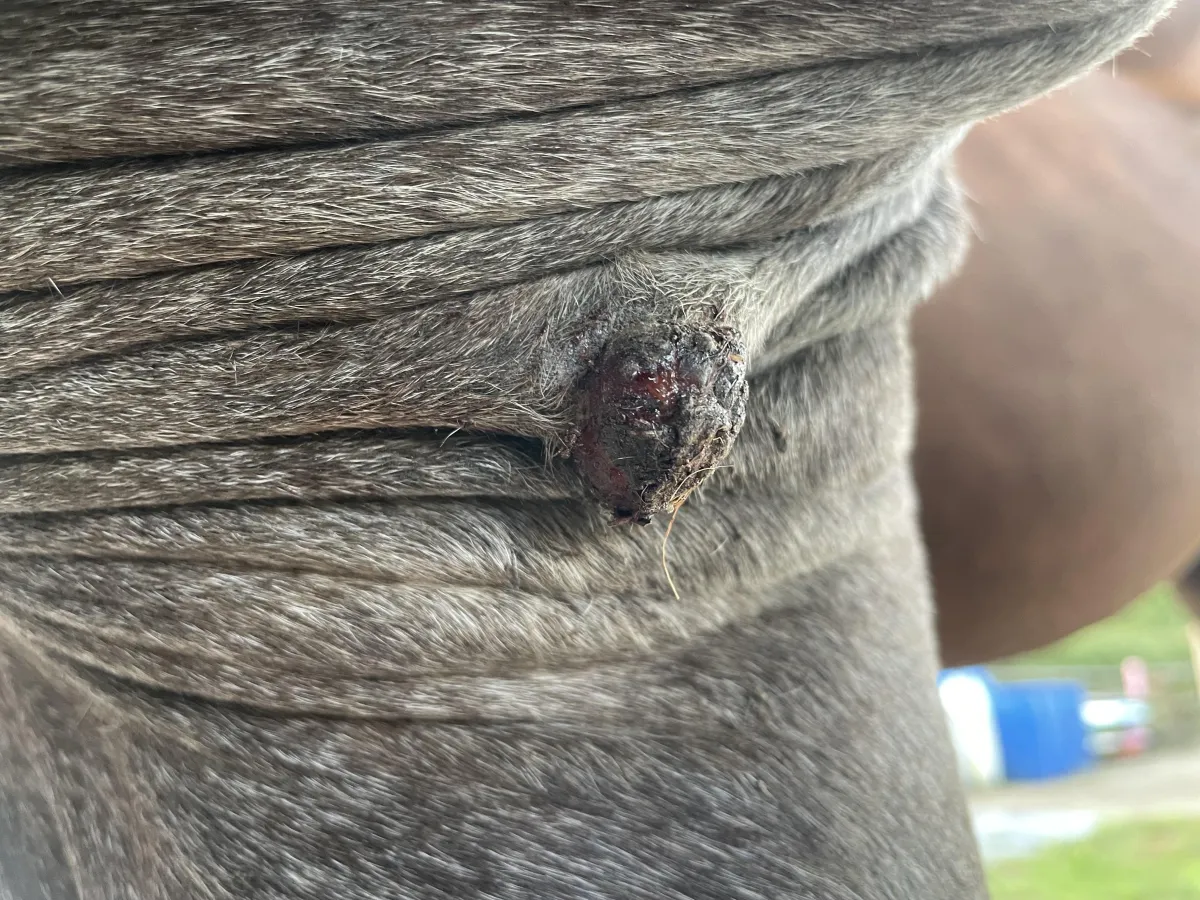
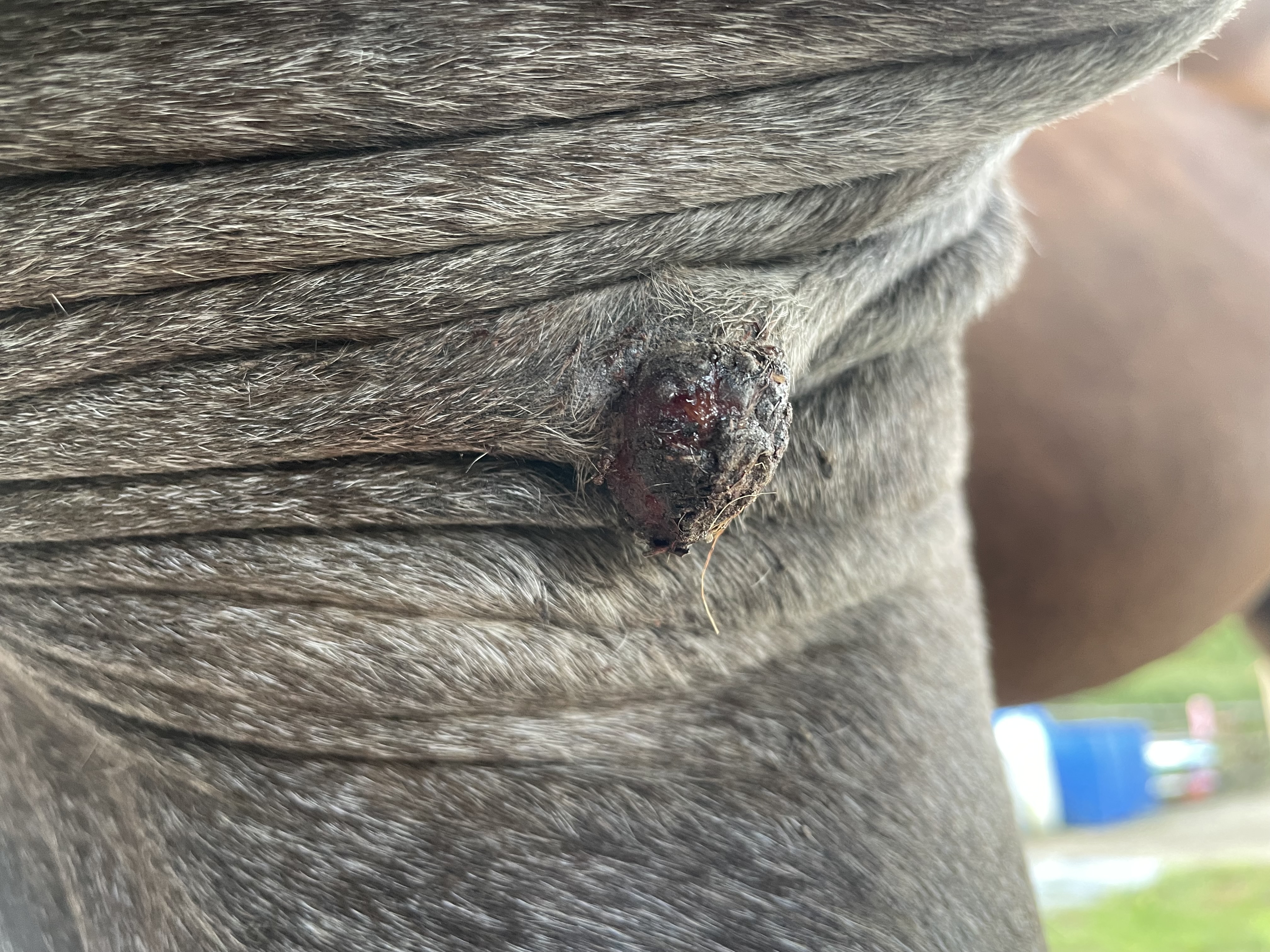
Some sarcoids—particularly fibroblastic ones—can become:
Ulcerated
Bleeding
Prone to infection
This creates an ongoing cycle of:
Inflammation
Tissue damage
Further tumour stimulation
At this stage, the issue becomes less about the tumour itself and more about chronic wound management and discomfort.
4. Treatment complications and recurrence
Another often overlooked factor is that sarcoids can become more problematic after inappropriate or incomplete treatment.
Evidence shows that:
Incomplete surgical removal can trigger aggressive regrowth
Trauma to the lesion may stimulate progression
Some treatments result in recurrence rates that are clinically significant
In other words, poorly managed sarcoids can become more severe than untreated ones.
Can sarcoids lead to euthanasia?
While rare, there are situations where sarcoids contribute to euthanasia decisions.
This is not because they are life-threatening in a biological sense, but because they can become:
Too extensive to manage
Located in areas that prevent normal function
Chronically painful or infected
Resistant to treatment
For example:
Large, invasive sarcoids around the eye may impair vision
Extensive lesions on limbs can affect mobility
Severe sheath involvement can be difficult to manage
In these cases, welfare—not mortality risk—is the deciding factor.
Are all sarcoids equally serious?
No—and this is where nuance matters.
Sarcoids are classified into several types, including:
Occult (flat, subtle lesions)
Verrucose (wart-like)
Nodular
Fibroblastic (aggressive, fleshy)
Mixed forms
Less aggressive types may:
Remain stable for long periods
Cause minimal disruption
More aggressive types may:
Grow rapidly
Ulcerate
Become difficult to treat
This variability is why blanket statements about risk are often misleading.
A common misconception
A frequent assumption is:
“If it’s not life-threatening, it’s not serious.”
That’s not accurate.
Sarcoids occupy a middle ground:
Not malignant in the traditional sense
But not harmless either
They are better understood as a chronic, potentially progressive condition that requires informed management.
What should owners focus on instead?
Rather than asking whether sarcoids are life-threatening, a more useful approach is to assess:
Is the sarcoid changing in size or appearance?
Is it located in a high-risk area?
Is it interfering with the horse’s comfort or use?
Has it been disturbed or treated previously?
These factors are far more predictive of outcome than the label “tumour” alone.
Practical takeaway
Sarcoids in horses are not usually life-threatening, but they should not be dismissed as insignificant.
They can:
Progress unpredictably
Become locally invasive
Affect welfare and usability
The key is not urgency—but appropriate, informed management based on type, location, and behaviour.
Want to know even more about sarcoids - click here